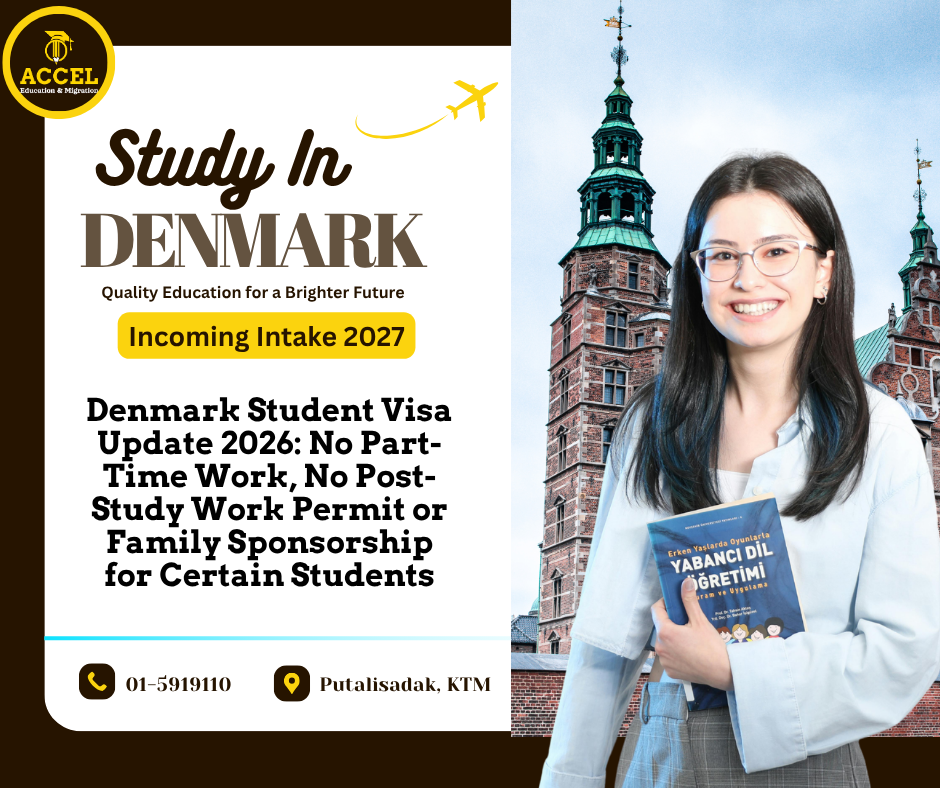
Denmark has introduced significant changes to its student residence permit rules, affecting certain international students enrolling in higher education programmes that are not approved by the Danish state.
The changes took effect on 2 May 2025 and are particularly important for students and other countries outside the EU/EEA who are considering less widely recognised or non-state-approved educational programmes.
Under these rules, eligible students applying for residence permits for non-state-approved higher education programmes may no longer receive permission to work alongside their studies, a post-study job-seeking stay, or residence permits for accompanying family members.
However, it is important to understand that these restrictions do not automatically apply to every private university or every international student in Denmark. The approval status of the specific programme and the date of the residence permit application are crucial.
In this blog, we explain the new rules, their impact on Nepali students, and what you should check before making your study-abroad decision.
What Has Changed in Denmark’s Student Visa Rules?
According to the Danish immigration authorities, the changes introduced on 2 May 2025 affect third-country nationals applying to study in non-state-approved higher education programmes.
The main restrictions are:
- No general student work permit: Eligible students applying under the new rules are not granted the usual limited work permit.
- No post-study job-seeking stay: These students are not eligible for the usual post-study job-seeking residence permit under this route.
- No accompanying family residence permits: Eligible students cannot obtain residence permits for accompanying family members under these rules.
These changes were introduced to ensure that student residence permits are used primarily for genuine educational purposes.
Official source: New to Denmark — Danish Agency for International Recruitment and Integration (SIRI).
1. Can Students Work Part-Time While Studying in Denmark?
One of the biggest concerns for international students is whether they can work part-time to help cover their living expenses.
Under the new rules, students who apply for residence permits for covered non-state-approved higher education programmes on or after 2 May 2025 are not granted the limited student work permit normally associated with state-approved programmes.
This means that students in the affected category should not plan to finance their education through part-time employment in Denmark.
Working without the required authorisation can have serious consequences, including fines or the revocation of a residence permit.
By comparison, students enrolled in state-approved higher education programmes generally have different work rights. Under the standard rules, eligible students may work up to 90 hours per month from September to May and full-time during June, July and August, subject to the conditions of their residence permit.
Important: Never assume that you can work simply because a Danish institution has offered you admission. Check the immigration conditions for your exact programme before accepting an offer.
2. Is a Post-Study Work Visa Available After Graduation?
Many students choose Denmark because they hope to gain international work experience after completing their degree.
However, the new rules create an important limitation for students in covered non-state-approved programmes.
Students who applied for a residence permit under this category on or after 2 May 2025 are not eligible for the usual post-study job-seeking stay associated with the relevant study route.
This means that completing the programme does not automatically give these students permission to remain in Denmark to search for employment.
Students enrolled in eligible state-approved programmes may have different post-study options. The length and conditions of any job-seeking permit depend on the applicable rules, the programme and the student’s circumstances.
Therefore, if your main goal is to work in Denmark after graduation, you should carefully investigate the approval status of your course and the residence permit conditions before applying.
3. Can Students Bring Their Spouse or Children to Denmark?
Family reunification is another important consideration for students planning to move abroad with their families.
Under the rules introduced on 2 May 2025, students applying for residence permits for covered non-state-approved higher education programmes on or after that date cannot obtain accompanying-family residence permits through this student route.
This restriction affects spouses, registered partners, cohabiting partners and children who would otherwise seek permission to accompany the student under the relevant provisions.
For families planning to relocate together, this is a particularly important issue.
Students applying to eligible state-approved programmes may have different family sponsorship options, subject to the applicable immigration requirements.
If you intend to travel with your spouse or children, confirm your eligibility before paying tuition fees or making relocation arrangements.
4. Do These Rules Apply to All Private Universities in Denmark?
No. This is one of the most important distinctions students need to understand.
The official rule refers to non-state-approved higher education programmes. This is not necessarily the same as saying that every institution described as a private university is affected.
The relevant question is whether the particular higher education programme falls within the category covered by the Danish immigration rules.
Before applying, students should verify:
- Whether the institution and specific programme are state-approved.
- Whether the programme qualifies for the intended student residence permit.
- Which work rights are attached to that permit.
- Whether a post-study job-seeking stay is available.
- Whether accompanying-family residence permits are permitted.
Do not rely solely on an education agent’s promotional material, an institution’s website or the word “university” in a programme’s name.
Always verify the position with the official Danish immigration authorities.
5. Who Is Affected by the Changes?
The rules are particularly relevant to non-EU/EEA students considering non-state-approved higher education programmes.
The application date also matters.
Students who applied for or were granted a residence permit under the relevant category before 2 May 2025 are generally covered by transitional arrangements and may retain the rights available under the earlier rules.
The new restrictions apply to relevant student residence permit applications submitted on or after 2 May 2025.
Special circumstances and exceptions may apply, so students should check their individual situation with SIRI.
6. What Should Students Check Before Applying?
For students, choosing a study destination requires more than comparing tuition fees or looking at the possibility of earning money abroad.
A course that appears affordable may not be the right option if it does not offer the work, family or post-study rights you expect.
Before making a final decision, consider the following checklist:
Check 1: Programme approval
Confirm whether the exact programme is state-approved and how it is classified under Danish immigration rules.
Check 2: Work opportunities
Ask what work authorisation is available with the specific residence permit. Do not assume part-time work will be permitted.
Check 3: Post-study opportunities
Confirm whether the programme leads to eligibility for a post-study job-seeking residence permit and what conditions apply.
Check 4: Family plans
If you want to bring your spouse or children, verify whether they can qualify for accompanying-family residence permits.
Check 5: Financial planning
Prepare a realistic budget for tuition fees, accommodation, food, transport, insurance and other living expenses. Make sure your financial plan does not depend on unauthorised employment.
Check 6: Official verification
Read the latest information published by Denmark’s official immigration authorities before paying a deposit or submitting an application.
7. Is Denmark Still a Good Study Destination?
Denmark may still be a suitable destination for some international students, but the right choice depends on your academic goals, budget, chosen programme and long-term plans.
Students who want to gain international qualifications should compare the quality and recognition of their intended programme, total study costs, residence permit conditions and career opportunities after graduation.
If part-time earnings, post-study employment or moving with family are essential to your plans, these factors should be evaluated before choosing a course.
A study destination should be selected based on accurate information and a realistic understanding of its immigration requirements—not simply because an institution offers admission.
Final Thoughts
Denmark’s changes, effective from 2 May 2025, are an important reminder that not all study programmes provide the same immigration benefits.
For eligible students applying to covered non-state-approved higher education programmes, the restrictions on student work, post-study job-seeking stays and accompanying-family residence permits can significantly affect their plans.
For students, the best approach is to check the approval status of the exact programme and confirm all relevant residence permit conditions before making a financial commitment.
Thinking about studying in Denmark? Make an informed decision before you apply. Speak with a qualified education counsellor and verify your eligibility through Denmark’s official immigration website.