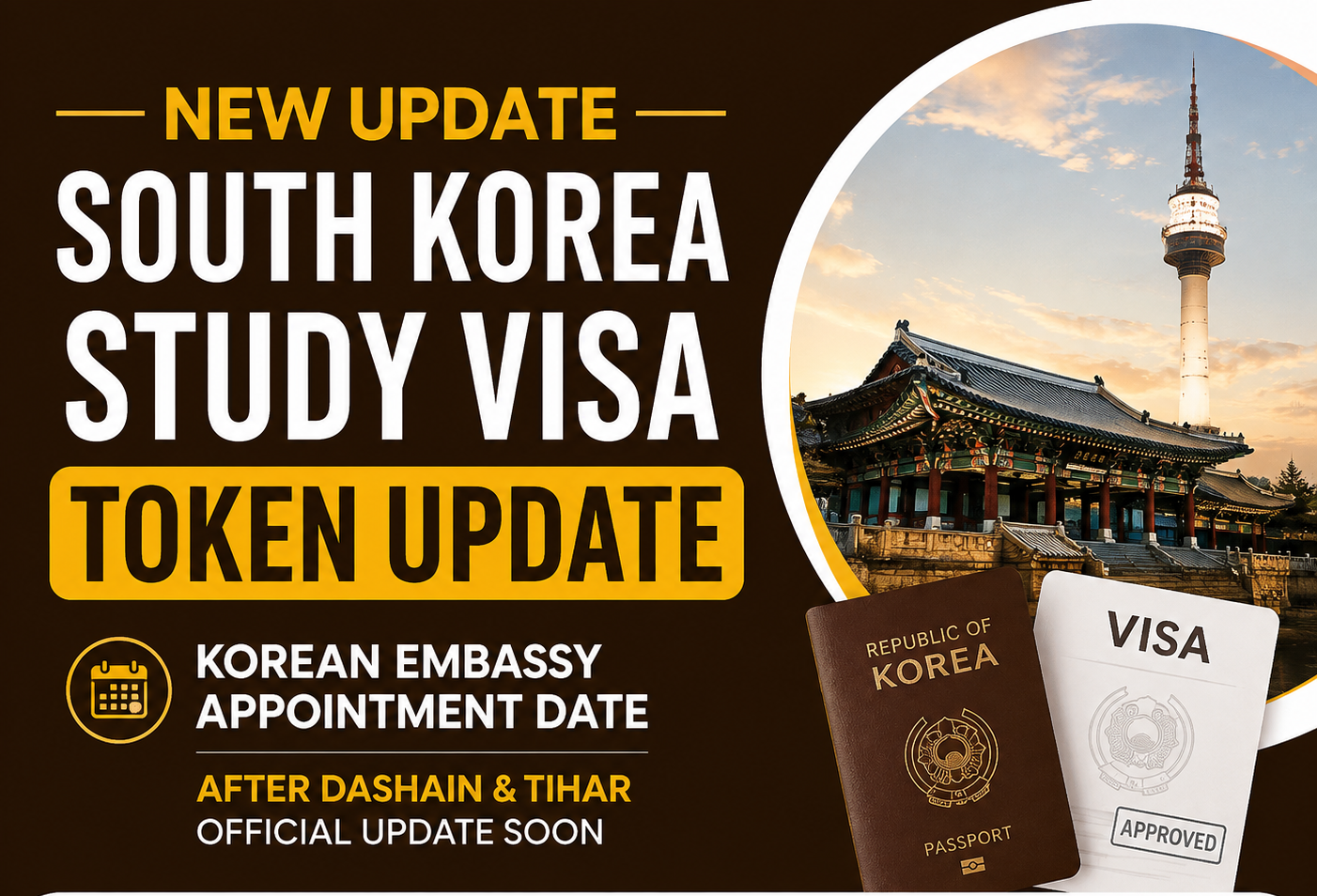
South Korea continues to attract students looking for affordable international education, quality universities and strong career opportunities. But in 2026, students planning to study in Korea need to pay close attention to visa appointments, document verification and the updated application process.
One of the biggest concerns among students right now is:
“When will the Korea student visa token or appointment system reopen?”
This has become an important question for students preparing for the upcoming intakes.
🇰🇷 What is the latest Korea visa update?
The Korean Embassy in Nepal has introduced several changes to its consular and visa procedures during 2026.
The Embassy’s official visa notice list currently includes:
- Updated D-2 and D-4 student visa document requirements
- Changes related to academic qualification verification
- Visa processing-time notices
- Updated visa fees/exchange-rate information
- Operation of the Korea Visa Application Center in Nepal.
The Embassy’s April 24, 2026 notice specifically provides preparation information for D-2 and D-4 visas for stays longer than 90 days
🎓 D-2 vs D-4 — Which visa do you need?
| Visa | Main purpose |
| D-2 | Bachelor’s, Master’s, PhD and other degree programs |
| D-4 | Korean language/training and other non-degree programs |
A D-2 applicant normally needs admission to a Korean degree program before applying for the student visa. For example, Korea University explains that degree-seeking international students must obtain a D-2 visa before beginning their studies.
A D-4 route is generally used by students going to Korea primarily for language training before progressing toward further studies.
What about the new token/appointment system?
This is where students need to be careful. There are many discussions among education consultancies and students about Korea Embassy tokens/appointments, but students should not rely only on Facebook posts or consultancy announcements.
The official Embassy has confirmed that some consular authentication appointment reservations were fully booked, and the Embassy stated that information regarding the resumption of reservations would be announced later. The notice specifically said that the expected announcement would come after the Dashain or Tihar holidays.
However, this particular notice is about consular authentication appointments, not a blanket official announcement saying that all D-2/D-4 visa tokens will reopen after Dashain/Tihar.
Therefore, students should wait for the official Embassy announcement before assuming a specific D-2 or D-4 token opening date.
Why is this important for students?
For students preparing for Korea, the visa appointment/token stage is only one part of the process. You should ideally prepare your documents before the appointment system opens. That means you should not wait until the token opens to start preparing.
Prepare these early:
✅ Passport
✅ Academic certificates and transcripts
✅ Graduation certificate
✅ University admission/acceptance documents
✅ Financial documents
✅ Visa application form
✅ Required photographs
✅ Health/TB-related documents where applicable
✅ Academic document verification/legalization as required
✅ Study plan/SOP where applicable
✅ Other documents specified by the Embassy or university
The Embassy also published a May 2026 notice emphasizing the submission of graduation certificates as academic qualification evidence when applying for a study visa.
📚 What should D-2 students know?
D-2 is generally the more direct route for students who already have admission to a Korean degree program.
Students may apply for programs such as:
- Bachelor’s degree
- Master’s degree
- PhD
- Other eligible degree-level programs
The most important point is that your academic background, chosen course, university, financial documents and overall study purpose should make sense together.
Don’t choose a university simply because someone says the visa is “easy.” Your academic progression and genuine study plan matter.
🇰🇷 What about D-4?
D-4 is mainly associated with language/training programs. For students who want to improve their Korean before entering a degree program, a university-affiliated Korean language institute can be an option. Later, depending on eligibility and university requirements, a student may pursue a degree and the appropriate D-2 status.
But students should understand that D-4 and D-2 are not the same visa, and requirements can differ.
💰 Financial preparation is still important
One of the biggest mistakes students make is focusing only on the token. Getting an appointment does not mean getting a visa.
Your financial documents need to meet the current requirements applicable to your case, and the exact amount/document format can depend on the university, program and Embassy requirements.
For this reason, students should always verify the latest requirement rather than relying on an old “Korea visa checklist” circulating on social media.
📅 What should students do before Dashain & Tihar?
If you’re planning for the next Korea intake, this is the preparation period—not the waiting period.
Before the token/appointment opens:
Step 1: Choose your course and university.
Step 2: Check your academic eligibility.
Step 3: Prepare your academic documents.
Step 4: Complete the required verification/legalization process.
Step 5: Prepare financial documents.
Step 6: Get your admission documents.
Step 7: Prepare your visa file according to the latest Embassy checklist.
Step 8: Monitor the Korean Embassy’s official notices for the appointment/token opening.
This can save students valuable time when appointments become available.
⚠️ Don’t believe every “Korea token open” post
This is especially important in 2026. You may see posts saying: “Korea token opening tomorrow! “D-2 token confirmed!” “D-4 token guaranteed!”
“Apply now and get direct Embassy date!”
Before paying money or submitting your passport/documents, verify the announcement through the official Embassy or authorized visa application channel. The Korean Embassy in Nepal has an official visa-information section where students can check current notices.
🎯 Why should students start now?
Because the token is not the first step. Your Korea study journey should look more like:
Course Selection → University Application → Admission → Document Preparation → Verification → Visa Preparation → Appointment/Token → Visa Application → Visa Decision → Korea 🇰🇷
If you start preparing only after the token opens, you may lose valuable time.
🇰🇷 Final message for students
If your plan is to study in South Korea, don’t wait for the token announcement to start preparing. Start your university selection, academic documents, financial preparation and visa file now.
The Korean Embassy has already issued several 2026 updates affecting student-visa documentation and consular procedures, so students should follow the latest official requirements rather than old checklists or social-media rumours.
And regarding the often-mentioned “after Dashain/Tihar” reopening, remember that the official notice currently available specifically concerns consular authentication appointment reservations. A separate official announcement should be checked before claiming that D-2/D-4 visa tokens themselves will open on a particular date.
For more detail about studying in south korea you can contact us in our landline num 015919110 or you can visit us @ACCEL education and migration services, we are happy to assist you.